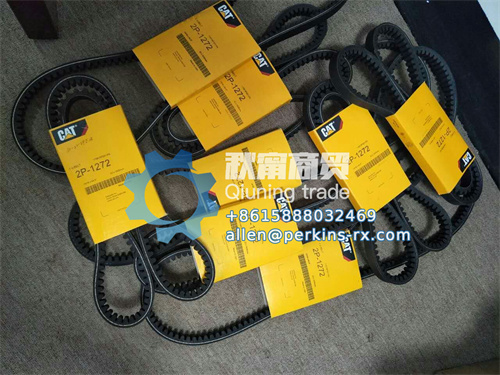
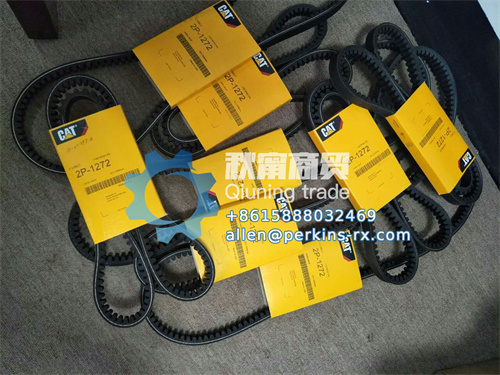
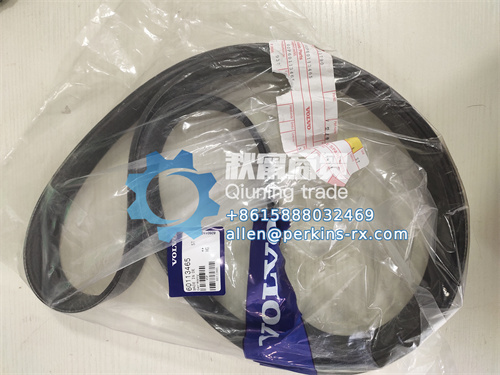
The "power link" for equipment transmission - Caterpillar 2P-1272 belt
In the power transmission of construction machinery equipment, the belt is the "core link" connecting the engine with accessories (such as water pumps, generators, compressors, etc.), and its stability directly determines the operational efficiency of the gear train and the continuity of equipment operation. Caterpillar's 2P-1272 belt, with its core features of "original factory-level precise fit" and "all-scenario durable design", serves as a reliable guarantee in high-load scenarios. Its value lies not only in "transmission", but also in the dual functions of "pulley guard system and stable power".
Original factory compatibility: Eliminate the risk of "transmission deviation"
As an original parts of Caterpillar, the length, width and groove curvature of the 22-1272 are perfectly matched with the gear train of the equipment (such as the engine wheel sets of models like 320D and 336D) (for specific compatible models, please consult customer service). The wheel groove fit customized through the original factory's 3D scanning ensures that the contact area with the pulley is over 95% - avoiding the "excessive local force" (causing premature cracking of the belt) or "insufficient contact" (resulting in slippage, abnormal noise, and power transmission loss exceeding 10%) caused by dimensional deviations in general belts. This "exclusive fit" enables the belt and the gear train to form a "seamless collaboration", eliminating the premature aging of accessories such as water pumps and generators caused by transmission deviations from the source.
Materials and craftsmanship: Hard power to cope with extreme working conditions
It adopts a structure of "high-strength core wire + composite rubber layer" and is refined through 28 processes:
Tensile core: The core wire is made of high-modulus polyester fiber, with a breaking strength of up to 2000N/mm². It can withstand the instantaneous tensile force during sudden acceleration of the equipment (such as sudden reversing of an excavator), and the long-term elongation rate is less than 1%, avoiding transmission lag caused by relaxation.
Weather-resistant rubber layer: The outer rubber layer is added with antioxidants and ultraviolet absorbers. It does not harden at -40℃ (remains elastic in northern winters) and does not soften at 80℃ (in the high-temperature environment of the engine compartment). Its oil resistance (resistant to erosion by hydraulic oil and diesel) is 50% higher than that of ordinary rubber.
Anti-flex process: The side of the belt is specially vulcanized, which is resistant to repeated bending (under the working condition of over 3,000 bends per hour, the service life is 60% longer than that of aftermarket parts), and avoids cracking or delamination (commonly seen in construction site scenarios with frequent starts and stops).
Scene Adaptation: The "Stable Transmitter" under All Working conditions
In complex scenarios such as mines and construction sites, the advantages of the 2P-1272 are particularly prominent:
Anti-dust adhesion: Anti-sticking coating is added to the rubber surface to reduce the "dynamic balance imbalance" caused by dust accumulation at the construction site (avoiding abnormal vibration and noise of the gear train).
Anti-slip design: The meshing Angle between the channel cross-section and the wheel groove has been optimized, increasing the friction by 20% compared to ordinary belts. Even in rainy and humid environments (with a small amount of water on the belt), it can still stably transmit power.
Vibration buffering: The damping characteristics of the rubber layer can absorb the high-frequency vibration of the gear train (amplitude ≤2mm), reduce the impact on the water pump bearings and generator shafts, and indirectly extend the service life of accessories by 30%.
Implicit value: "Low-cost insurance" for reducing downtime
The value of a high-quality belt lies in its "few malfunctions" :
Gear train protection: Stable transmission reduces pulley wear and avoids "wheel biting" caused by belt deviation (the cost of repairing the gear train exceeds 10,000 yuan).
Reduced downtime: The weather-resistant design extends the replacement cycle to 2,000 hours (about 800 hours for aftermarket parts), reducing 2 to 3 downtime replacements each year and saving over 5,000 yuan in labor costs.
Stable power: The non-slippage transmission ensures more stable water supply by the water pump and power generation by the generator, avoiding equipment alarms caused by excessively high water temperature (insufficient water pump efficiency) or unstable voltage (generator transmission lag).
Maintenance suggestions
It is recommended to check every 500 hours
Observe whether the belt has cracks or delamination (with a focus on the bends).
Press the middle of the belt with your finger. The deflection should be between 10 and 15mm (if it is too loose, it will slip; if it is too tight, it will damage the bearing).
Clean the oil stains and dust in the pulley groove (to avoid a decrease in the friction coefficient).
When replacing, original factory tools must be used (to avoid forcibly prying and damaging the gear train). After the new belt is installed, it should idle for 10 minutes and then retighten the tensioner pulley once.
Choosing the Caterpillar 2P-1272 belt is essentially buying a "stability insurance" for the equipment's gear train - it is not merely a transmission belt, but also an "invisible cornerstone" that ensures the continuous transmission of power, allowing heavy-duty equipment to always be "as agile as a rabbit" under complex working conditions, reducing the worry of faults and providing more peace of mind during operation.