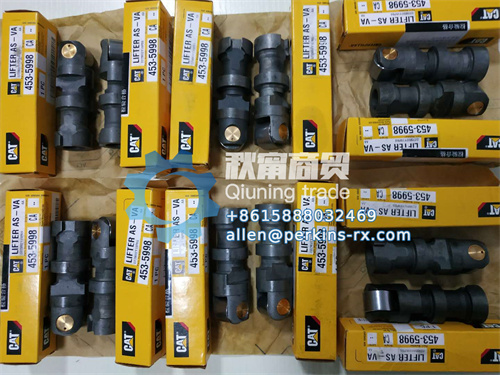
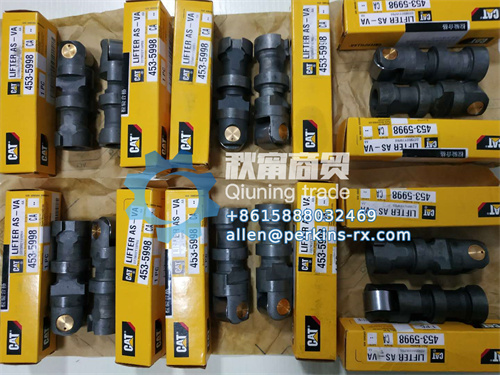
The "precise transmission hub" of the valve train system - CAT Caterpillar valve trector 453-5998
In the engine valve train system, the valve tappets serve as the "moving bridge" connecting the camshaft and the valves. Their precision and durability directly determine the accuracy of valve opening and closing as well as the combustion efficiency of the engine. The CAT Caterpillar 453-5998 valve tantler, with "original factory-level precise fitting" and "enhanced design based on working conditions" at its core, has become the key to the stable operation of high-load equipment. Its core value lies in the deep integration of "precise motion transmission" and "tolerance to extreme environments".
1. Original factory Compatibility: Eliminate the risk of "gas distribution error"
As an original parts of CAT, the length and diameter of 453-5998 fully comply with the design standards of the C9 engine in terms of the fit clearance between the camshaft peach tip and the valve stem tail end (for specific compatible models, please consult customer service). The spherical curvature calibrated by the original factory three-coordinate measuring instrument ensures that the friction torque when in contact with the camshaft is controlled within 0.5-0.8N · m (to avoid excessive clearance causing abnormal noise and too small clearance causing jamming), and the valve lift error is less than 0.02mm. This "native fit" ensures that the timing of the valve train is always in sync with the engine speed, eliminating from the source the problems of "insufficient intake" or "incomplete exhaust" caused by dimensional deviations in the universal tachyps.
Ii. Materials and Craftsmanship: Hard Power to Cope with High-frequency Impacts
It is made of 20CrMnTi high-strength alloy steel and refined through a four-step process of "forging - carburizing - quenching - grinding".
Core toughness: After quenching and tempering treatment, the core hardness reaches HRC28-32, which can withstand an instantaneous impact force of over 5000N when the camshaft is running at high speed (such as in the rapid acceleration condition of an excavator), avoiding fracture.
Surface hardness: The depth of the carburized layer is 0.8-1.2mm, and the surface hardness reaches HRC58-62. The wear resistance is 60% higher than that of ordinary carbon steel, reducing abnormal wear on the camshaft peach tip and the spherical surface of the tapers.
Geometric accuracy: Spherical roundness error < 0.001mm, cylindricity tolerance ±0.005mm, ensuring uniform force distribution during movement and reducing vibration and noise of the gas distribution mechanism by more than 15%.
This design enables the tongs to have a lifespan 40% longer than that of spare parts in scenarios with "sudden changes in camshaft load" such as high-frequency reversing of excavators and heavy-load climbing of loaders.
Iii. Detail Design: The protective ingenuity Hidden in the "spherical surface" and "Oil Groove"
Convex surface flow guidance design: The spherical surface of the twill has been optimized through curvature calculation to guide the lubricating oil to be evenly distributed to the CAM contact area, increasing the heat dissipation efficiency by 25% and avoiding metal sintering caused by local overheating.
Lightweight structure: Under the premise of maintaining strength, the weight is reduced by 8% compared with similar products, reducing the inertia of the reciprocating motion of the valve spring and improving the high-speed response speed of the engine.
Wear-resistant coating: A solid lubricating coating of molybdenum disulfide is added to the spherical edge. The oil film formation time during cold start is shortened by 30%, reducing "dry friction" damage. It is especially suitable for operation in low-temperature environments.
Iv. The "Systemic Value" of Engines
The stable tappet performance actually builds an "efficient valve train chain" for the engine:
Combustion optimization: Precise valve train increases the intake volume by 3%, ensuring more complete fuel combustion, stable engine power output, and a 5% reduction in power loss under heavy load conditions.
Component extension: The low-friction design reduces the wear of camshafts and valve stems, extending the major overhaul cycle by more than 20% and lowering the risk of "insufficient cylinder pressure" caused by valve seal failure.
Fault prevention: The shock-resistant structure prevents fatal faults such as valve drop and piston ejector caused by tappet fracture, making it particularly suitable for high-intensity scenarios where equipment operates continuously for over 12 hours.
Choosing original factory valve tappets is essentially a "preventive investment" in the engine's valve train system, avoiding the high maintenance costs of losing the big picture for small gains.
Maintenance suggestions
It is recommended to check the condition of the tincts after major engine overhauls or every 2,000 hours of operation, with a focus on observing whether there are scratches, depressions or abnormal wear on the spherical surface. When replacing, they should be replaced in pairs (to avoid uneven gas distribution caused by the gap difference between new and old parts), and the valve clearance should be adjusted to the standard value (0.25-0.30mm) using the original factory tools. If abnormal noises from the engine or a decrease in power are detected during daily use, it is necessary to promptly check the wear of the tanner.
CAT Caterpillar 453-5998 valve tanner defines the valve train transmission standard with "original factory precision" and responds to extreme loads with "enhanced craftsmanship". It is not merely a transmission component, but also the "precise hub" for the efficient operation of the engine - from material selection to geometric accuracy, every design aspect is empowering the valve train efficiency, component lifespan and equipment reliability. Choosing the original factory tappets means choosing the maintenance approach of "low wear and high reliability", ensuring that construction machinery always maintains strong power and stable performance on heavy-load journeys.