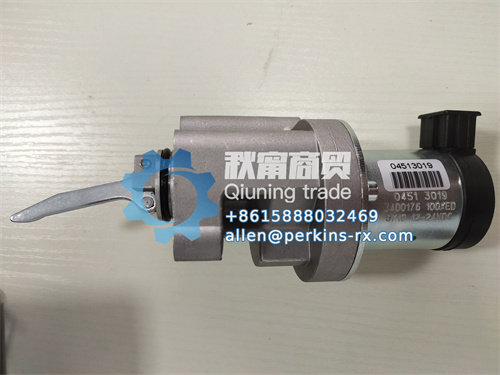
The "power transmission center" of the fuel system - Deutz 02112673 fuel transfer pump
The fuel pump is the "first power source" of the fuel system, responsible for pressurizing the fuel in the tank and delivering it to the injectors. Its stability directly determines whether the fuel injection system can work accurately. The DEUTZ 02112673 fuel pump, with its original factory level design and detailed polishing, has become the core of ensuring fuel delivery efficiency. Its value lies not only in "fuel delivery", but also in its dual role of "stable supply" and "system protection".
As an original accessory of Deutz, the interface and pressure parameters of 02112673 are perfectly matched with the engine fuel pipeline (specific compatible models can be consulted with customer service). From the inlet diameter to the outlet pressure threshold, they are all tested and calibrated by the original factory to ensure a "seamless link" with the fuel tank, filter, and injector - avoiding the "fuel supply fluctuation" caused by unstable pressure in the universal fuel pump: high pressure may impact the injector, while low pressure may cause insufficient fuel supply, leading to engine power fluctuations. The original factory adaptation ensures that the fuel delivery pressure remains stable in the optimal range (about 0.3-0.5MPa), providing a "continuous and balanced" fuel source for the fuel injection system.
Its core advantage lies in its "anti cavitation and voltage stabilization design". When the fuel pump is working, if bubbles are mixed into the fuel (such as low fuel level in the tank or leakage in the pipeline), it is easy to cause "cavitation" phenomenon (bubble rupture and impact on the valve core), leading to interruption of fuel delivery. 02112673 adopts a precision exhaust structure, which can quickly remove bubbles in the fuel. At the same time, the valve core is polished with a mirror surface and matched with an oil resistant sealing ring to reduce pressure loss. Even under low temperature (-30 ℃) or high fuel viscosity conditions, it can stably absorb and deliver oil, avoiding fuel supply interruption caused by cavitation or jamming.
Material selection should adapt to complex environments. The body is made of high-strength alloy cast iron, which has a 30% improvement in fuel corrosion resistance compared to ordinary cast iron and can resist sulfide corrosion in low-quality fuel; The internal spring is made of fatigue resistant steel, which maintains elasticity after 100000 expansion tests, ensuring stable oil pressure during long-term use. This durability enables it to exhibit better stability than auxiliary components in scenarios such as long-distance transportation of commercial vehicles (frequent start stop) and field operations of construction machinery (with high dust and vibration), reducing the risk of mid journey breakdowns caused by oil pump failures.
For the fuel system, a stable fuel pump hides "preventive protection": continuous stable fuel supply can avoid wear and tear of injectors caused by unstable fuel supply; The anti cavitation design reduces the impact of bubbles on the precision components of the fuel injector, indirectly extending the life of the fuel injection system. Compared to the maintenance costs of fuel injectors caused by fuel pump failures, the investment in original fuel pumps is more cost-effective in the long run.
Maintenance suggestion: It is recommended to check the status of the fuel pump every 80000 kilometers or when there is poor fuel supply (such as difficulty starting or idle shaking), with a focus on checking whether the inlet pipeline is leaking and whether the filter screen is blocked; When replacing, priority should be given to using original parts to ensure that they match the pressure parameters of the fuel system and avoid affecting fuel supply efficiency due to improper adaptation.